Vendor managed inventory software: 7 VMI tools compared
Ivan de Ramon8 min read
On this page
Vendor managed inventory software lets a supplier see a customer's stock, compare it with an agreed minimum and maximum, and create the replenishment order. This page compares 7 VMI software tools: who each one is built for, how stock data gets in, and what it costs.
All facts come from each vendor's own website, checked on November 19, 2026. Each tool links to the page we read. Prices and features change, so check the page before you decide.
New to the model itself? Read how vendor managed inventory works first. This page is about the software.
VMI software compared
| Tool | Built for | How stock data gets in | Public price |
|---|---|---|---|
| TrueCommerce Datalliance VMI | Suppliers that replenish distributors and retailers | EDI 852/INVRPT, XML or flat file | No |
| eTurns TrackStock | Distributors that manage customer stockrooms and trucks | QR code scans, electronic shelf labels, RFID, weight sensors | Yes, from $40 per stockroom per month |
| Advantive VMI software | Wholesalers, distributors and their suppliers | Shared sales and stock data, mobile scanning | No |
| Generix Collaborative Replenishment | Manufacturers that manage customer warehouses | EDI messages, ERP connection | No |
| SAP Business Network for Supply Chain | Buyers and suppliers that work with SAP | Buyer shares stock and min/max levels on the network | No |
| RedBeam RFID | Suppliers that stock customer sites with tagged items | RFID readers, REST APIs | Yes, per user |
| SupplyOn VMI, Kanban, JIT/JIS | Manufacturers and their suppliers | EDI, APIs, web services, ERP adapters | No |
What VMI software has to do
Every VMI system does the same five jobs. Use them as a checklist in a demo.
- Hold the rules. A min and a max for each item at each customer location.
- Get the stock data. How much is on the shelf and how much was used, every day or every week.
- Work out the order. Compare stock with the min and max and with a forecast, then suggest a quantity.
- Create and send the order. Into the supplier's own ERP, and as a confirmation to the customer.
- Report. Stock, fill rate and usage for each customer, so both sides can check the program.
The tools differ most in job 2. That is also where most VMI programs fail: if the count is wrong or late, the order is wrong.
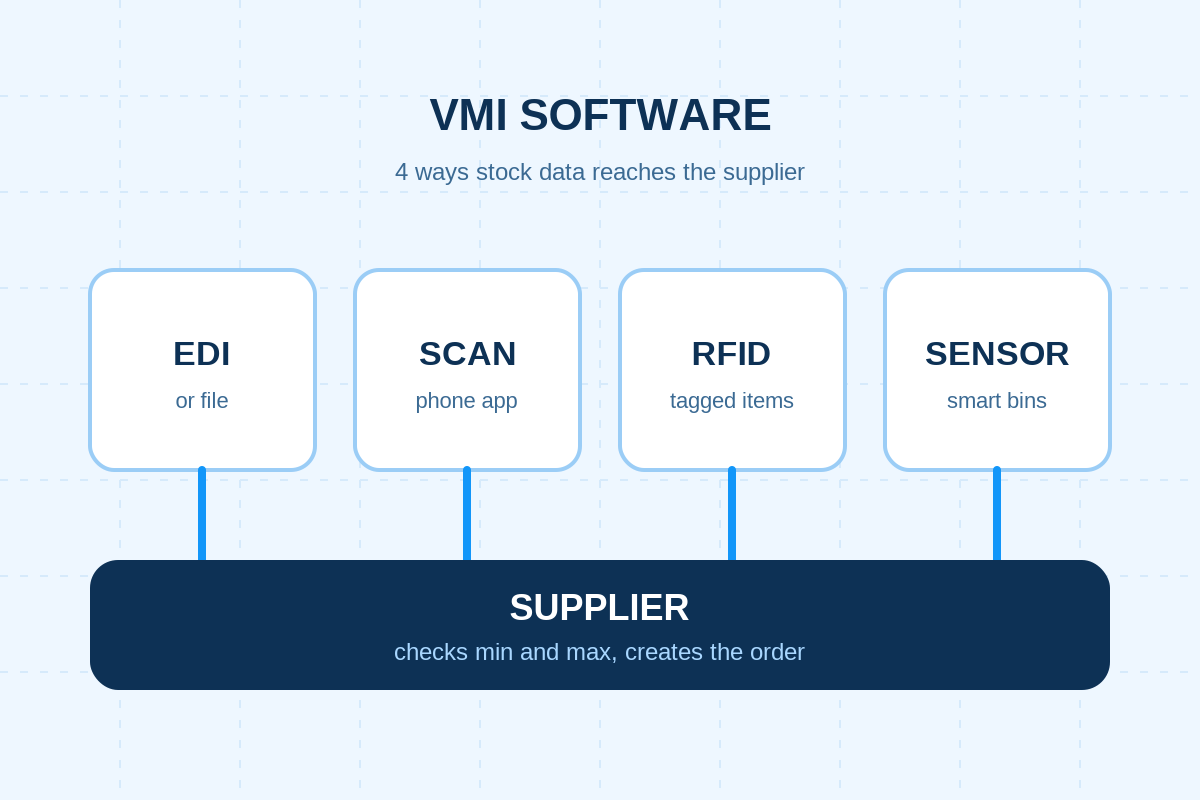
4 ways stock data gets into a VMI system
| Method | How it works | Fits |
|---|---|---|
| EDI or file | The customer's system sends a stock and sales report, for example EDI 852 | Customers with an ERP and an IT team |
| Mobile scanning | A person scans a bin label with a phone and enters the count or the order | Stockrooms, service trucks, small sites |
| RFID | Readers pick up tagged items when they move | Higher-value items, many movements |
| Weight sensors and smart bins | The bin reports its own level | Small parts with steady use, sites nobody visits often |
A simple rule: if your customers can send data from their ERP, look at the EDI tools. If they cannot, somebody or something has to count on site, and you need scanning, RFID or sensors.
The 7 VMI software tools
1. TrueCommerce Datalliance VMI
TrueCommerce Datalliance VMI is built for suppliers. It receives product activity data from the customer as EDI 852/INVRPT, XML or a flat file. It then recommends orders, and the supplier reviews them and creates the purchase order on behalf of the customer, sent as EDI 850/875/ORDERS or a flat file.
TrueCommerce says the product "can support any replenishment model and scale to any number of locations". The page shows no price.
Fits: a manufacturer or supplier whose customers can send EDI or files.
2. eTurns TrackStock
eTurns TrackStock is built for distributors that run VMI in their customers' stockrooms. Counts and orders use min and max levels. Data comes in through QR code scans, electronic shelf labels, RFID or SensorBins, which are bins on weight sensors that report counts without a visit.
It is the only tool in this list with a full public price list: four plans at $40, $100, $249 and $399 per stockroom per month, billed semi-annually, and a free 30-day trial. Hardware costs extra. eTurns gives about $96 per item for SensorBins.
Fits: a distributor that manages bins at customer sites or on service trucks and wants to start small.
3. Advantive VMI software
Advantive's VMI software is aimed at wholesalers and distributors and their suppliers. Advantive says it shares sales and stock data in real time, forecasts demand by item and warehouse, and places orders automatically when stock reaches the set minimums and maximums. A mobile app lets a person scan and count, or scan and enter an order quantity.
The page shows no price.
Fits: a distributor and supplier pair that want one shared view of stock and automatic min/max orders.
4. Generix Collaborative Replenishment
Generix Collaborative Replenishment (GCR) helps manufacturers manage their customers' inventory in several countries. It loads EDI messages from trading partners automatically and connects to the ERP for master data. Generix names AB InBev as a customer, with 87 warehouses and 7 distributors in 4 countries.
The page shows no price.
Fits: a large manufacturer that replenishes many customer warehouses.
5. SAP Business Network for Supply Chain
SAP calls the model supplier-managed inventory and says it is the same as VMI. The supplier keeps an agreed stock of material, usually at the buyer's site, and the buyer shares stock and min/max levels over the network. In November 2026 SAP announced a project with Pirelli to run its VMI processes on SAP Business Network for Supply Chain.
The pages we read show no price.
Fits: a company that already runs SAP and wants its suppliers on the same network.
6. RedBeam RFID
RedBeam RFID takes the counting out of VMI. Items carry RFID tags, readers at the customer site record when stock moves, and the supplier sees the levels at every customer location. REST APIs push the movement data to an ERP or MRP system, and RedBeam names SAP as an example.
RedBeam publishes list prices per user on its pricing page. You also need RFID tags and readers.
Fits: a supplier with higher-value items at customer sites, where a missed count is expensive.
7. SupplyOn VMI, Kanban, JIT/JIS
SupplyOn runs VMI, Kanban and JIT/JIS on one platform with one supplier interface. It connects through EDI, APIs, web services and ERP adapters, in formats such as EDIFACT, XML and CSV, and it gives VMI replenishment proposals from inventory and stock movement data.
The page shows no price.
Fits: a manufacturer that already manages plants and suppliers with Kanban or just-in-time delivery.
How to choose VMI software
Answer three questions in this order.
1. Which side are you on? Most VMI software is built for the supplier, because the supplier does the work. If you are the customer, your job is to send clean stock data, and your supplier chooses the system.
2. Can your customers send data? If they have an ERP and can send EDI or files, a data exchange tool fits: TrueCommerce, Generix, SAP or SupplyOn. If they cannot, you need on-site counting: eTurns, Advantive's mobile app or RedBeam.
3. How many sites, and how much is a site worth? A tool that costs $40 a month per stockroom pays off at a small customer. A project with EDI setup and a sales call usually needs larger volumes to pay off. Ask each vendor for the cost of one extra customer site.
Then ask every vendor the same things:
- How do you set and update min and max? By hand, or from usage data?
- What happens when a count is missing or late?
- Which ERP systems do you write orders into?
- What does one more customer location cost?
- Can the customer see their own stock and orders?
The numbers behind VMI: min, max and forecast
VMI software moves data and orders. The result still depends on the numbers inside it. A min that is too low gives stockouts at the customer. A max that is too high fills their shelf with your money.
Both numbers come from the same inputs: average usage, how much usage swings, and lead time. You can check them with the free reorder point calculator and safety stock calculator.
Convexity covers this planning side for distributors: demand forecasting for every SKU, inventory optimization that sets stock levels, and purchase suggestions by vendor that a person approves.
Frequently asked questions
What is VMI software?
VMI software is a system a supplier uses to manage stock at a customer's site. It holds a minimum and maximum for each item, reads the customer's stock and usage, and creates the replenishment orders.
How much does VMI software cost?
Most vendors do not publish prices. Of the 7 tools on this page, eTurns TrackStock lists $40 to $399 per stockroom per month, billed semi-annually, and RedBeam lists prices per user. The other five ask you to contact sales. Checked on November 19, 2026.
Does VMI software need EDI?
No. EDI is one way to get stock data from the customer. Tools such as eTurns TrackStock use phone scans, shelf labels, RFID or weight sensors instead, and RedBeam uses RFID readers.
What is the difference between VMI software and inventory management software?
Inventory management software tracks your own stock in your own warehouse. VMI software tracks stock that sits at your customer's site and creates the orders to refill it.
Who uses VMI software, the supplier or the customer?
Mostly the supplier. In VMI the supplier decides when and how much to ship, so the supplier runs the system. The customer shares data and can usually see stock and orders.