Vendor managed inventory (VMI): how it works, with an example
Ivan de Ramon5 min read

On this page
Vendor managed inventory (VMI) is a supply chain setup where the supplier, not the buyer, watches the buyer's stock and decides when and how much to ship. The buyer shares stock and sales data and agrees on a minimum and maximum level for each item. The supplier keeps the stock inside that range.
This guide explains how VMI works, how it differs from consignment and normal buying, the pros and cons for both sides, and a worked example for a distributor.
How vendor managed inventory works
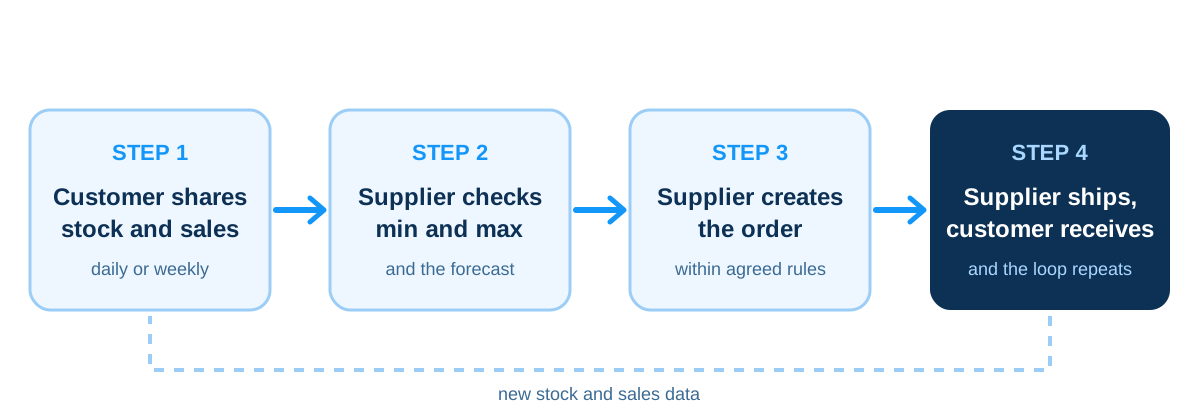
- The customer shares data. Stock on hand, sales or usage, and open orders, every day or every week. This usually goes by EDI, a supplier portal or a file export.
- The supplier checks the levels. It compares the stock with the agreed minimum and maximum and with its forecast for the next weeks.
- The supplier creates the order. It follows the agreed rules: which items, which min and max, which order and delivery days. Some contracts let the supplier ship directly. Others create a purchase order that the customer approves.
- The supplier ships and the customer receives. The new stock and sales data go back to step 1.
Before VMI starts, both sides agree on these points in writing:
- The items covered
- Min and max for each item and location
- What data the customer shares, how often and in which format
- Who owns the stock, and from when
- The service target, for example a fill rate
- What happens to slow or dead stock
VMI vs consignment vs normal buying
| Normal buying | Vendor managed inventory | Consignment | |
|---|---|---|---|
| Who decides when to order | Customer | Supplier | Supplier |
| Who owns the stock on site | Customer, from delivery | Usually the customer, from delivery | Supplier, until it is used or sold |
| When the customer pays | Invoice terms after delivery | Invoice terms after delivery | After use or sale |
| Data shared | Purchase orders | Stock, sales, forecasts | Stock and usage |
| Typical items | Most purchases | Steady, repeat items | Expensive or slow items |
The two are often combined. In consignment VMI, the supplier manages the stock and also owns it until the customer uses it.
Benefits of vendor managed inventory
For the customer:
- Less time spent buying routine items.
- Fewer stockouts, because the supplier sees a problem before it happens.
- Often less stock on hand, because the supplier plans with real usage data.
For the supplier:
- A view of real demand, not just orders. This reduces the bullwhip effect, where small changes in sales turn into big swings in orders.
- Smoother production and shipping.
- A closer customer. Once VMI runs well, switching suppliers takes work.
Drawbacks of vendor managed inventory
- The customer gives up control and has to trust the supplier.
- The data must be right. Wrong stock counts lead to wrong orders.
- Setup takes work: data feeds, a contract, and min and max for every item.
- If the contract rewards volume, the supplier may push more stock than needed.
- It does not suit items with rare or irregular demand.
Vendor managed inventory example
A fastener distributor runs VMI for a manufacturing customer. For one item, M8 bolts, they agreed:
| Rule | Value |
|---|---|
| Average usage | 400 boxes a week |
| Lead time, order to delivery | 1 week |
| Min | 600 boxes |
| Max | 1,600 boxes |
| Stock count | Every Monday |
The rule: if the stock would fall below the min before a delivery can arrive, order up to the max.
Week 1. The customer reports 1,200 boxes. After one more week of usage, stock would be 1,200 − 400 = 800. That is above the min of 600, so no order.
Week 2. The customer reports 800 boxes. After one week, stock would be 800 − 400 = 400. That is below 600, so the distributor orders 1,600 − 400 = 1,200 boxes. When they arrive, stock is back at 1,600.
The customer never places an order, and the stock stays between the min and the max. The same logic works for hundreds of items, as long as the usage data is fresh and the min and max are right. To set them, see safety stock and reorder points.
When VMI makes sense for a distributor
Distributors sit in the middle of the supply chain, so they can be on either side of VMI.
- The distributor as the supplier. You manage stock at your customers' sites: bins on a factory floor, an MRO store room, a shelf at a contractor. This is common for fasteners, MRO supplies, packaging and chemicals.
- The distributor as the buyer. A manufacturer manages its own products in your warehouse.
VMI works well when items are steady and repeat, the customer buys enough to justify the setup, stock data can be shared every week or more often, and both sides put the rules in writing. It works badly for one-off items, lumpy demand, or when nobody trusts the stock counts.
What VMI software needs to do
Whether you run VMI for customers or let suppliers run it for you, the system needs to:
- Keep a min and max for each item and location.
- Read stock and sales from each site, by EDI, file or API.
- Forecast demand per item, not just repeat last month.
- Suggest or create orders inside the agreed rules.
- Show stock and service level per customer.
Convexity covers the planning side for distributors: demand forecasting, inventory optimization and purchase suggestions based on both.
Frequently asked questions
What is vendor managed inventory in simple words?
The supplier looks after the customer's stock. The customer shares how much it has and how much it uses, and the supplier decides when to send more.
What is an example of vendor managed inventory?
A fastener distributor counts the bins at a factory every Monday and refills them to an agreed level. The customer never places an order. The worked example above shows the numbers.
What is the difference between VMI and consignment?
VMI is about who decides when to order: the supplier. Consignment is about who owns the stock: the supplier, until the customer uses it. A deal can be one, the other, or both.
Who owns the stock in vendor managed inventory?
Usually the customer, from the moment of delivery, like a normal purchase. If the deal is also consignment, the supplier owns it until it is used or sold.
What is a vendor managed inventory system?
Software that holds the min and max for each item, reads stock and sales from the customer, forecasts demand, and creates the replenishment orders.