EOQ formula: how to calculate economic order quantity
Ivan de Ramon4 min read
On this page
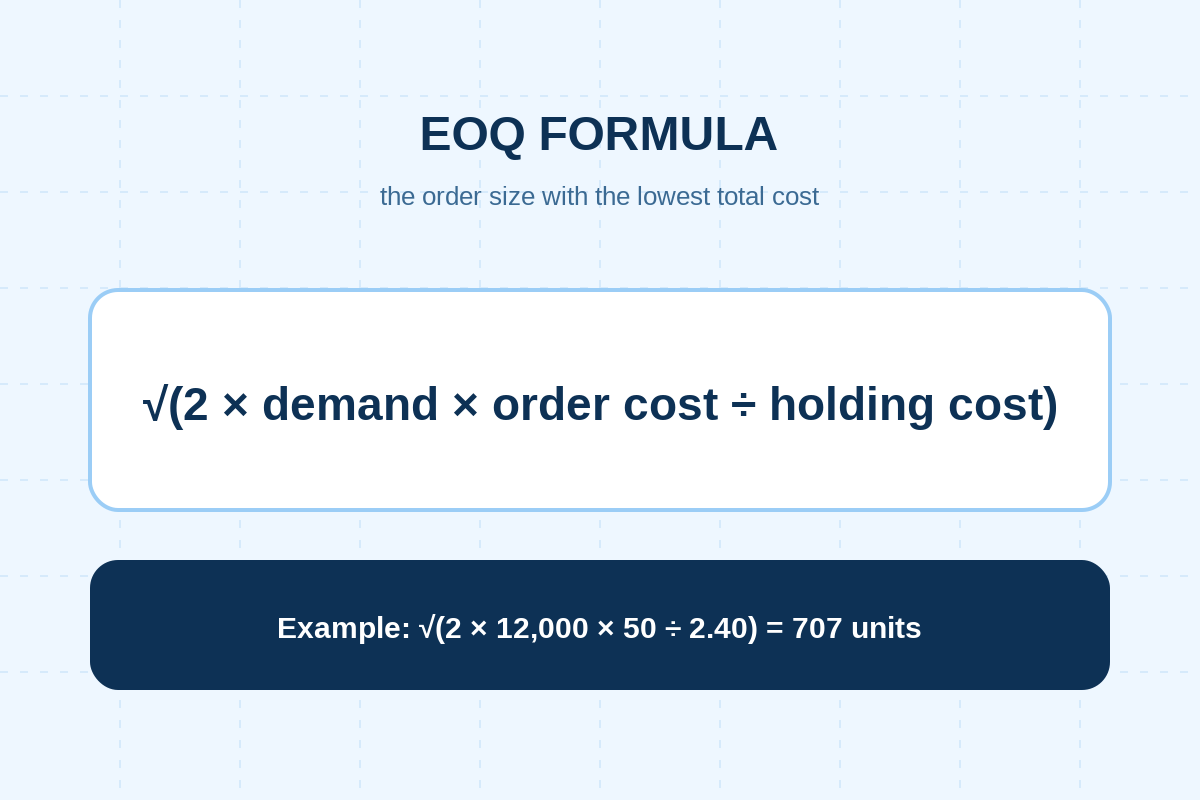
The EOQ formula is: EOQ = √(2 × annual demand × cost per order ÷ holding cost per unit per year). EOQ means economic order quantity: the order size where ordering cost and holding cost together are lowest. This guide explains the formula, works through an example and gives you a calculator.
EOQ calculator
Enter your yearly demand, what one order costs you and what it costs to hold one unit for a year.
Economic order quantity:
Rounded up: 708 units per order, which means about 16.9 orders a year.
Ordering plus holding cost at 708 units per order: $1697.06 a year. This leaves out the price of the goods.
Round to your case pack and supplier minimum before you order.
The EOQ formula
EOQ = √(2 × D × S ÷ H)
| Letter | What it means | Example |
|---|---|---|
| D | Annual demand in units | 12,000 units |
| S | Cost to place one order | $50 |
| H | Cost to hold one unit for one year | $2.40 |
Order cost (S) is what changes each time you order: the buyer's time, freight, receiving and any fixed fee. Do not count rent or salaries that stay the same.
Holding cost (H) is what it costs to keep one unit for a year: the money tied up in it, storage, insurance and shrink. Many companies use a percent of the unit cost. A unit that costs $12 with a 20% holding rate costs $2.40 a year to hold.
Worked example
Demand is 12,000 units a year. One order costs $50. Holding one unit costs $2.40 a year.
EOQ = √(2 × 12,000 × 50 ÷ 2.40) = √500,000 = 707.1 units
Rounded up, you order 708 units each time. That means 12,000 ÷ 708 = about 17 orders a year, or one order every 3 weeks.
Why this order size is the cheapest
Two costs pull in opposite directions:
- Ordering cost per year = (D ÷ Q) × S. Small orders mean many orders.
- Holding cost per year = (Q ÷ 2) × H. Big orders mean more stock on the shelf. Q ÷ 2 is the average stock, because stock falls from Q to zero between orders.
Q is the order size. At the EOQ the two costs are equal, and their sum is at its lowest.
| Order size | Orders a year | Ordering cost | Holding cost | Total |
|---|---|---|---|---|
| 300 | 40 | $2,000 | $360 | $2,360 |
| 708 (EOQ) | 17 | $847 | $850 | $1,697 |
| 1,000 | 12 | $600 | $1,200 | $1,800 |
| 2,000 | 6 | $300 | $2,400 | $2,700 |
The total leaves out the price of the goods, because you buy 12,000 units either way.
Close to the EOQ is good enough
The total cost changes little near the EOQ. An order 20% bigger than the EOQ raises the total by less than 2%. So you can round to a case pack, a pallet or a full week of supply without losing much.
What EOQ assumes
- Demand is steady through the year.
- The order cost and the holding cost are known and do not change.
- The whole order arrives at once.
- The price per unit is the same for any order size.
When the formula is wrong
- Price breaks. If the supplier gives a discount above a quantity, compare the total cost at the EOQ with the total cost at the discount quantity, including the price of the goods.
- Supplier minimums. If the EOQ is below the minimum order, order the minimum.
- Free freight above an amount. Test that order size against the EOQ.
- Seasonal demand. EOQ uses one yearly number. For seasonal items, calculate per season.
- Goods that expire or go out of fashion. Shelf life can matter more than the cost balance.
- A holding cost that is a guess. A wrong holding cost gives a wrong answer. Check it with your finance team.
EOQ, reorder point and safety stock
EOQ tells you how much to order. It does not tell you when. You need three numbers per item:
- Safety stock: the buffer. See the safety stock formula.
- Reorder point: when to order. See the reorder point formula.
- Order quantity: how much. This page.
For a full catalog, inventory optimization software works out all three for every item and respects supplier minimums, case packs and container sizes.
Frequently asked questions
What is the EOQ formula?
EOQ = √(2 × annual demand × cost per order ÷ holding cost per unit per year). Example: √(2 × 12,000 × 50 ÷ 2.40) = 707.1 units.
What does EOQ stand for?
Economic order quantity. It is the order size with the lowest total of ordering cost and holding cost.
How do I calculate EOQ in Excel?
Put annual demand in A1, cost per order in B1 and holding cost per unit per year in C1. The formula is =SQRT(2A1B1/C1).
What is a good EOQ?
There is no general good number. It rises when demand is high or ordering is expensive, and falls when holding stock is expensive.
Does EOQ work with a minimum order quantity?
Yes, as a starting point. If the EOQ is below the supplier minimum, order the minimum. If it is above, round to the nearest case pack.