Demand Forecasting
See what is likely to sell before deciding what to buy.
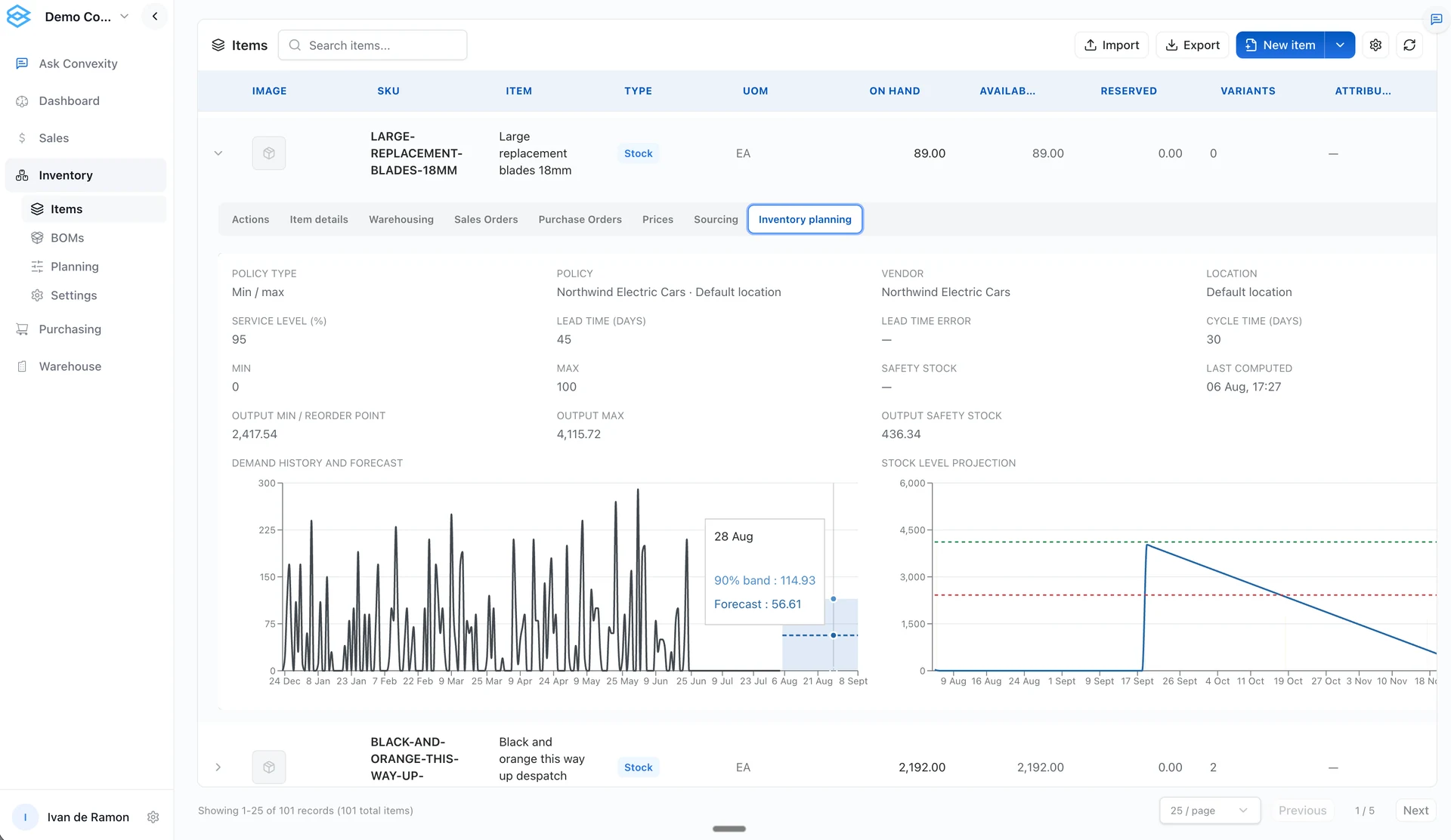
Convexity provides SKU-level demand forecasting for distributors and wholesalers, connecting sales history, inventory context, and purchasing decisions.
Forecast demand for each SKU
A purchasing team needs more than a total sales forecast. It needs to see which items are moving, which have gone quiet, and where a fall in sales may reflect unavailable stock. Convexity brings item-level forecasts and inventory analysis into the purchasing workflow.
What goes into a useful forecast?
Historical sales by SKU and date, with consistent item identifiers.
Current stock and item status, so active and inactive products can be interpreted correctly.
Seasonal patterns and known changes that your planners can explain.
The buying horizon and supplier lead times needed to turn a forecast into a purchasing decision.
New products, infrequent sales and periods out of stock need extra attention. Review these exceptions with your planner rather than treating every forecast as equally reliable.
How forecasting supports purchasing
Connect and check the history
Map sales and inventory records from the agreed source. Check SKU matches, date coverage, missing periods, and refresh frequency before relying on the model.
Review the item-level forecast
Compare expected demand with historical sales and stock levels. Use Ask Convexity to explore the underlying data and investigate changes.
Translate demand into a buy decision
Review the forecast alongside available stock, incoming purchases, supplier lead times, and buying constraints. Inventory optimization turns this context into suggested stock levels and purchase quantities.
Compare sales history with the forecast
Review revenue, gross profit and units sold over time to understand the business trend. Then open item-level planning to compare historical demand with a forecast. A sales dashboard explains what happened; the forecast helps you plan what comes next.
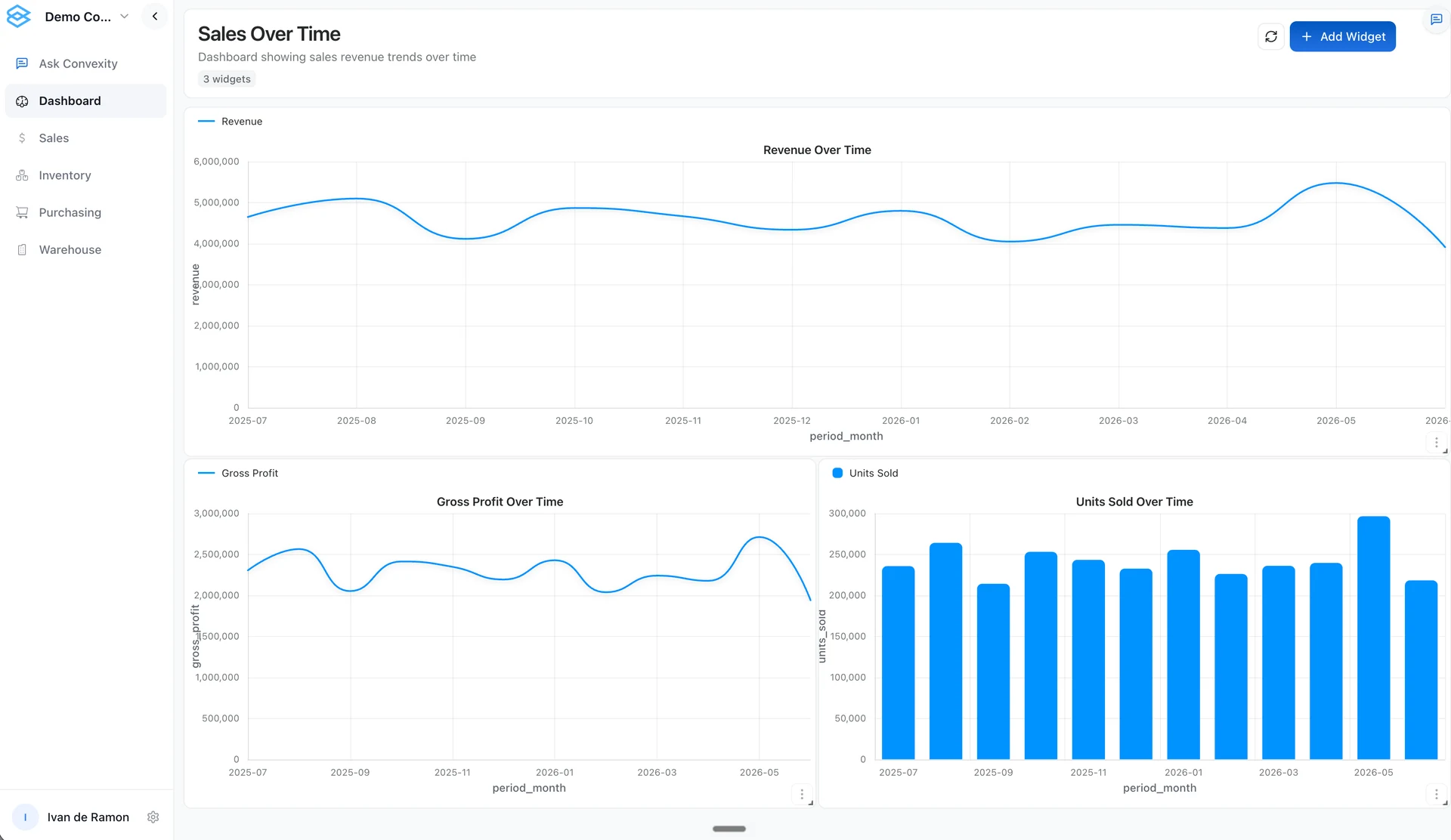
Example: finding products worth restocking
For a distributor with a changing catalog, a practical question is which out-of-stock or inactive items have a sales history worth reviewing. The planner can compare that history with current availability and supplier options before deciding whether to buy again. Past sales alone do not establish future demand.
Evaluate the forecast before relying on it
Test the forecast against sales from a period the model has not seen. Compare it with your current method, then review fast sellers, slow movers and stockout periods separately. Track purchasing results as well as forecast accuracy.
What your team can review
SKU-level demand forecasts alongside historical sales.
Inventory context for investigating potential shortages or excess stock.
The data behind a purchasing recommendation, with questions handled through Ask Convexity.
Exceptions that need a planner to supply business context or correct the input data.
A forecast is a planning estimate, not a guaranteed sales result. Agree how to check accuracy and data freshness before using it to commit purchasing spend.
Bring a sample sales-history export and a few difficult-to-plan SKUs. We will review the data and show how forecasting connects to a purchasing decision.
Book a demoFrequently asked questions
What is the difference between forecasting and inventory optimization?
Demand forecasting estimates future demand. Inventory optimization uses that estimate together with stock, supply, lead times, and buying constraints to recommend what to hold or purchase.
How much sales history do we need?
There is no single requirement for every catalog. Useful history depends on seasonality, item turnover, data quality, and the planning horizon. Review a sample export before agreeing model coverage; sparse or new-item histories need additional judgment.
Does the forecast update in real time?
Refresh frequency depends on the source system and configured data pipeline. Agree the refresh schedule and check the latest successful update. Do not assume a connected ERP means every forecast updates instantly.
Does Convexity guarantee a reduction in stockouts?
No fixed reduction is promised here. Outcomes depend on source data, supplier reliability, purchasing decisions, and implementation. Evaluate forecast quality and operational results against an agreed baseline.
Start with your workflow
Bring one inventory, purchasing or order-management problem. We will map the required data, demonstrate the relevant workflow and identify what needs configuration or further validation.
Book a demo